🇻🇪 Not just about the narcos: Trump's battle for the ballot
Is Trump's attack on Venezuela just about drugs? Reality is catching up with the conspiracy, it was just a matter of time.

Welcome new subscribers and THANK YOU to those who $upport my independent writing and advocacy.
In the late 1980s, Venezuela’s public universities were rarely a serious option. Between student protests and union strikes, it could take twelve years—or more—to graduate. Most of my friends chose private universities or planned to study abroad. That option disappeared after the 1984 currency devaluation and economic collapse, which made foreign education financially impossible for most families. As a result, admission into Venezuela’s private universities became brutally competitive.
Among the best of these institutions was Universidad Simón Bolívar (USB). Admission exams were conducted in person, and the names of those accepted were published nationally in the newspapers—often across a two-page centerfold. I vividly recall the phone calls; friends and relatives contacting my parents after recognizing my name in print.
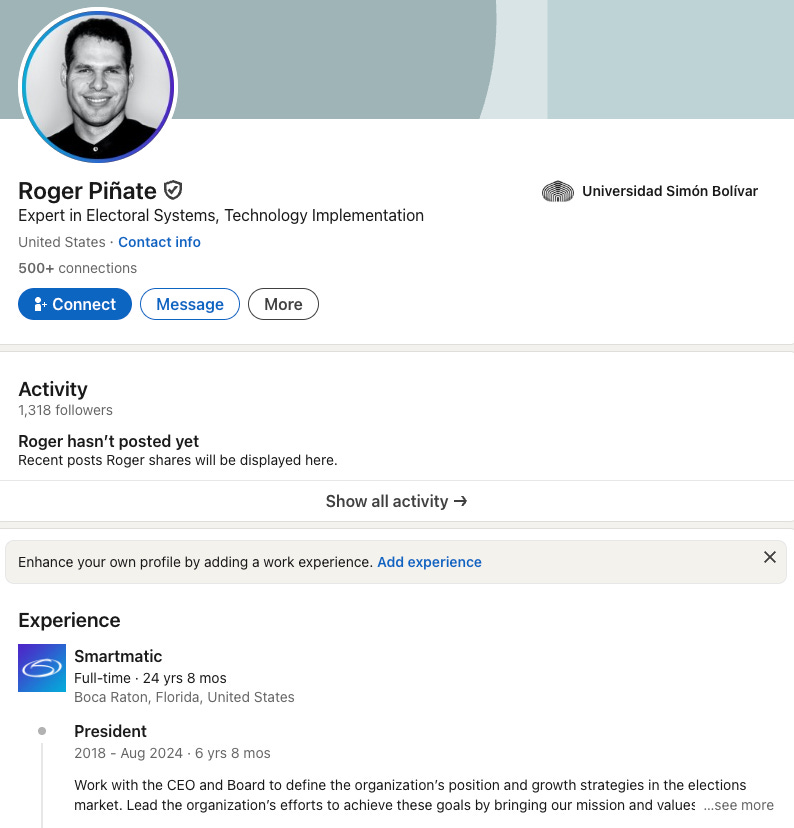
All of this matters because Smartmatic’s CEO, Roger Piñate, is a 1997 alumnus of USB, trained as an electronic engineer. By any reasonable measure, that alone places him among Venezuela’s intellectual elite. Thus, it is striking to consider that the election infrastructure developed by Piñate and his co-founder, Antonio Mugica (also a USB-trained engineer), would later be adopted by countries such as the Philippines, Argentina, Brazil, Ecuador, various nations in Africa—and ultimately, the United States.
During the Chávez and Maduro years, Venezuela’s Smartmatic-powered elections (covering everything from voter registration to tabulation) consistently produced results favorable to the regime. These elections were repeatedly marred by exit-poll discrepancies, statistical irregularities, and international controversy. For years, defenders of the system argued that no conclusive forensic proof of manipulation existed. That remained technically true … until 2017.
That year, Smartmatic itself publicly accused the Maduro government of fabricating turnout figures in the Constituent Assembly election by at least one million votes and immediately withdrew all operations from Venezuela. After nearly two decades of political dispute, the company’s own declaration marked the first direct confirmation that the system had been manipulated from within.
By that point, Smartmatic was no longer a small Venezuelan startup. It had been incorporated in Delaware in 2000, with an address in Boca Raton, Florida. By 2014, Mugica—together with British Lord Mark Malloch-Brown (closely tied to George Soros)—announced a new holding company whose primary asset was Smartmatic. Around that same period, I happened to meet Piñate’s wife socially. Among those of us from Venezuela’s old guard, their sudden wealth was noted quietly—and, at the time, privately questioned. In hindsight, those suspicions feel less speculative than they once did.
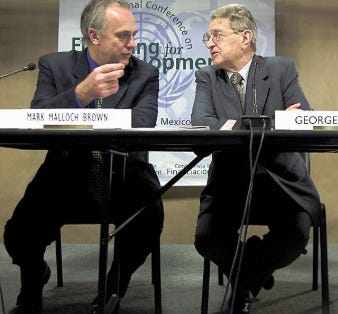
Lord Malloch Brown with George Soros at 2002 UN Conference
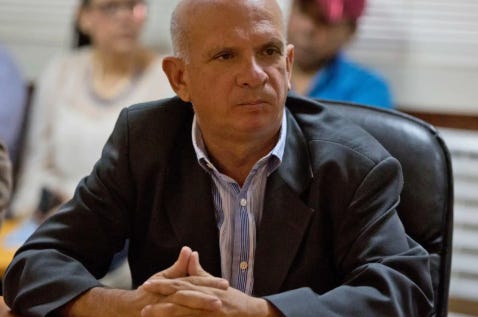
The core vulnerability here is structural: the ability to supply, operate, and audit voting machines end-to-end concentrates extraordinary power in very few hands. When that level of control exists alongside persistent statistical anomalies, suspicions naturally turn to software-level manipulation. With public testimony from Hugo “El Pollo” Carvajal—Venezuela’s former military intelligence chief—those suspicions have escalated into formal accusations that the Smartmatic system was altered and that the technology was later exported abroad. These claims remain allegations, but they now come from a former regime insider.

So how does all of this connect?
One plausible explanation is that powerful global interests ensured that aligned governments remained in power. Venezuela has long sat at the center of human trafficking, narcotics trafficking, and arms smuggling routes. According to Carvajal, U.S. diplomats and intelligence-linked intermediaries (read CIA) lent assistance to Chávez and later Maduro in maintaining control. Separately, public reporting confirms that former CIA Director John Brennan later became part owner of a Serbian data center used by Dominion Voting Systems—an overlap that has fueled further scrutiny, though not proof of coordination … yet.
When Chávez first rose to power, he did so legitimately, riding public exhaustion with Venezuela’s corrupt two-party system. Soon after, Cuban intelligence embedded itself deeply within the state, advising on constitutional restructuring and power consolidation. The weaponization of the drug trade against the United States—executed with the involvement of Hezbollah and Cuban networks—followed.
As U.S. pressure on Venezuela escalates under Trump, it became increasingly clear that narcotics are not the sole battlefield. The Venezuelan regime has waged a multi-front campaign through drugs, gangs, espionage, and even the democratic processes abroad. And as is so often the case, many institutions became entangled along the way. After all, money is the lubricant that keeps the machinery of bankers, real estate financiers, political operatives, and nonproductive intermediaries quietly moving.
Father in Heaven,
Grant wisdom to those who seek clarity, courage to those who speak it, and discernment to those who hear it. May no scheme outpace Your justice, and no deception outrun Your truth.
Steady our hearts, Lord, so we do not grow weary in the watch. Let righteousness not only be revealed—but prevail. We pray for the good people of Venezuela, may they soon be on a righteous path towards freedom. We pray for President Trump, may he be surrounded by good counsel and loyal advisors.
In Jesus’ mighty name,
Amen.
There is so much in this letter that we suspected and now is confirmed:
Hugo Carvajal's Open Letter to Trump
And here is oldie but goldie:
Venezuela's Third Fight for Freedom

As someone deeply immersed in Florida’s election security fight, I occasionally receive a “thank you for what you do.” Reflecting on recent events, I’ve come to realize that my advocacy doesn’t stem from being American, but because I am Venezuelan. The civic lessons ingrained in me during middle school while growing up there are what truly fuel my activ…